
How to Improve First-Pass Prior Authorization Approval Rates: A Provider’s Documentation Checklist
Your first-pass approval rate is the share of prior authorization requests approved on the first submission, with no resubmission, peer-to-peer, or appeal. It is the single best measure of whether your prior auth process is working.
Every request that misses on the first pass costs staff time, delays care, and puts revenue at risk. Many of those misses trace back to something the payer needed that wasn’t in the request. This post covers what a denial really costs and gives you a checklist your team can run before anything goes out the door.
WHAT A MISSED FIRST PASS REALLY COSTS
A denial isn’t the end of the request. It’s the start of a second, more expensive process.
– Staff time. Premier’s national survey of 516 hospitals found providers spent an average of $43.84 per claim fighting claim denials, and $47.77 per Medicare Advantage claim (STAT:
– Revenue that never comes back. In the AMA’s 2025 survey, 55% of physicians said they lack the staff or time to appeal denials, and 67% said past experience tells them an appeal won’t succeed (Becker’s, citing AMA:
When nobody appeals, the denial stands.
– Delayed care. In the same survey, 53% of physicians said patient care cannot wait for the health plan to approve the request (Becker’s, citing AMA:https://www.google.com/url?q=https://www.beckersasc.com/?p%3D103766&source=gmail&ust=1791314368301000&sa=E).
An approval on the first pass avoids all three. That makes the checklist below one of the cheapest revenue protections a practice has.
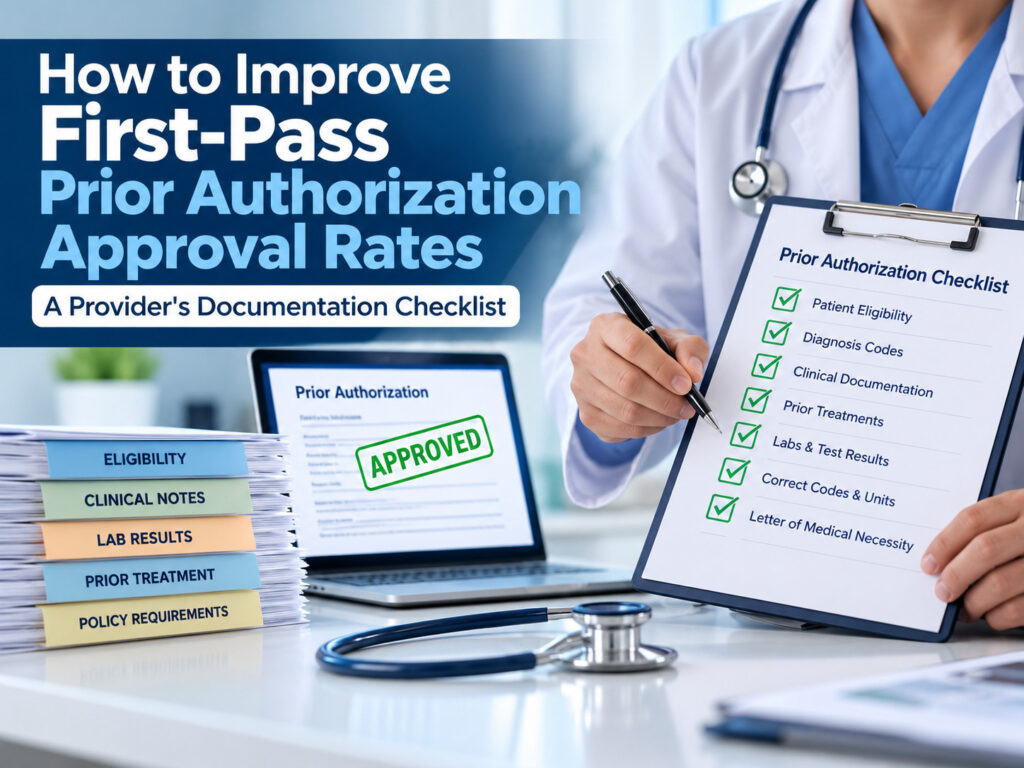
THE FIRST-PASS CHECKLIST
Run this on every request before it goes out. It’s grouped by when each step happens, because the cheapest time to fix a gap is before the patient leaves the office.
Before the order
Confirm the service, drug or code requires authorization under this patient’s specific plan. Payer lists change, so check the current one.
Verify eligibility, the active plan, and any secondary coverage that needs its own authorization.
For drugs, confirm whether the plan covers it under the medical benefit or the pharmacy benefit. They are often reviewed by different teams with different criteria.
Pull the payer’s current medical policy for this exact service or drug, including any site-of-care rules that restrict where an infusion can be given.
In the chart
The diagnosis codes match a covered indication in the payer’s policy, coded to the specificity the policy names.
Disease severity is documented with the objective measures the policy asks for, such as a scoring index, endoscopy findings or lab values, not just the word “severe.”
Prior treatments are listed with drug names, doses, dates, results, and the reason each was stopped. Step-therapy requirements live or die here.
Required labs, imaging, or screenings are on file and inside the payer’s time window. For many biologics, this includes infection screening such as TB or hepatitis B.
There is a signed order, and the prescriber meets any specialty requirement in the policy.
A recent clinical note ties it together: why this service, for this patient, now.
In the request
Every criterion in the policy points to a specific page or entry in the attached records.
Codes, billing units, dose, and site of care are correct and consistent across the order, the note, and the request. For drugs, check the HCPCS code, the NDC, and that units match the code’s billing increment.
Rendering provider and facility NPI and tax ID match where the service will actually happen.
Nothing contradicts itself, such as dates or doses that differ between documents.
A letter of medical necessity is attached when the case doesn’t fit the policy neatly.
At submission and after
Submit as expedited only when waiting the standard timeframe could seriously harm the patient’s health. Payers can downgrade requests that don’t qualify.
Log the submission date so you know when a decision is due, and follow up the day it’s late.
Once approved, check the approved dates, number of doses or visits, units, and site of care against the schedule. A dose or weight change, a new site, or an expired date range usually needs an updated authorization. Premier found that 3.2% of denied claims had already been approved through prior authorization (Healthcare Finance News: https://www.google.com/url?q=https://healthcarefinancenews.com/node/144782&source=gmail&ust=1791314368301000&sa=E).
Put the authorization number on the claim.
If it’s denied anyway, record the payer’s stated reason and update your checklist for that payer and service.
HOW TO MEASURE YOUR FIRST-PASS RATE
You can’t improve a number you don’t track. The math is simple:
First-pass approval rate = Requests approved on first submission / Total requests submitted
A few rules keep it honest:
– Count a request as a first-pass approval only if it was approved with no additional records, peer-to-peer or resubmission.
– Break it out by payer, by service or drug, and by the staff member who built the request. The overall number tells you if there’s a problem. The breakdown tells you where.
– Review it monthly, alongside the denial reasons you logged.
You’ll soon have outside numbers to compare against. Under CMS-0057-F, impacted payers must publicly report prior authorization metrics, with the first set due March 31, 2026 (TELCOR: https://www.google.com/url?q=https://telcor.com/cms-publishes-final-rule-streamlining-prior-authorization-process&source=gmail&ust=1791314368301000&sa=E).
THE BOTTOM LINE
A first-pass denial is often not a mystery. It is frequently something the payer asked for that the request didn’t show. A checklist run before submission catches those gaps when they take minutes to fix, not weeks.
Caldarium runs this check automatically, mapping the chart to each payer requirement and flagging what’s missing before the request goes out. See how it works:
https://www.google.com/url?q=https://caldarium.org&source=gmail&ust=1791314368301000&sa=E
SOURCES
– Insurance claim denials compromise patient care, provider bottom lines, STAT (Premier survey data): https://www.google.com/url?q=https://www.statnews.com/2024/05/01/insurance-claim-denials-compromise-patient-care-provider-bottom-lines/&source=gmail&ust=1791314368301000&sa=E
– Private payers deny 15% of claims, survey finds, Healthcare Finance News (Premier survey data): https://www.google.com/url?q=https://healthcarefinancenews.com/node/144782&source=gmail&ust=1791314368301000&sa=E
– Denials, delays and burdens keep growing: 10 new findings on prior auth, Becker’s ASC (2025 AMA survey): https://www.google.com/url?q=https://www.beckersasc.com/?p%3D103766&source=gmail&ust=1791314368301000&sa=E
– CMS publishes final rule streamlining prior authorization process, TELCOR: https://www.google.com/url?q=https://telcor.com/cms-publishes-final-rule-streamlining-prior-authorization-process&source=gmail&ust=1791314368301000&sa=E