
Prior Authorization Automation vs. Documentation Readiness: Why Faster Submission Isn’t Always Better
Most prior authorization software sells one thing: speed. Submit faster, track faster, hear back faster. That matters, but a fast submission that gets denied is still a denial. It just arrives sooner.
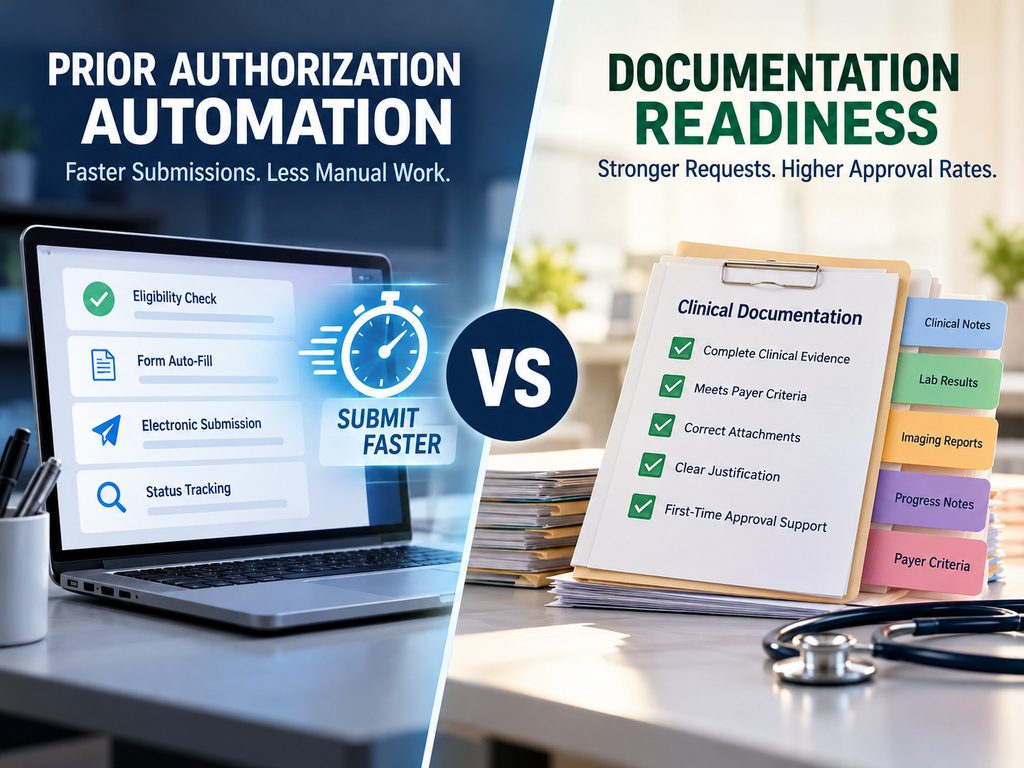
What actually protects revenue and patient access is getting the request approved the first time. That depends on what is in the request, not how quickly it was sent. This post breaks down what automation solves, what it doesn’t, and why documentation readiness is the step most practices skip.
WHAT AUTOMATION ACTUALLY FIXES
Automation attacks the clerical side of prior authorization, and that side is enormous. In the AMA’s 2025 physician survey, practices reported completing about 40 prior authorizations per physician each week, eating roughly 13 hours of physician and staff time
Moving those requests from fax and phone to electronic submission pays off. CAQH estimates that adopting the electronic standard would save the industry about $515 million a year and save providers 14 minutes per authorization (CAQH Index:
Good automation tools handle:
– Checking whether a service needs authorization at all
– Filling payer forms and portals without retyping
– Submitting electronically instead of by fax
– Tracking status so staff stop calling payers for updates
All of that is real value. None of it changes whether the payer says yes.
WHAT IT DOESN’T FIX: THE DENIAL
A denial is decided on content. The payer looks at the clinical evidence attached to the request and compares it to their criteria. Faster transport does nothing for a request that is missing the evidence.
The scale of the problem is large. In 2024, Medicare Advantage insurers received nearly 53 million prior authorization requests and fully or partially denied 4.1 million of them, or 7.7% (KFF: https://www.google.com/url?q=https://www.kff.org/medicare/issue-brief/medicare-advantage-insurers-made-nearly-53-million-prior-authorization-determinations-in-2024/&source=gmail&ust=1791314044932000&sa=E).
In the AMA survey, 75% of physicians said denials had increased over the last five years (Becker’s, citing AMA: https://www.google.com/url?q=https://www.beckersasc.com/?p%3D103766&source=gmail&ust=1791314044932000&sa=E).
Most denials are never challenged. KFF found only 11.5% of denied Medicare Advantage requests were appealed, yet 80.7% of those appeals ended with the denial partially or fully overturned (KFF, same link). That gap is lost care and lost revenue that a better first submission could have avoided.
Documentation sits at the center of this. A 2022 HHS Office of Inspector General review found that 13% of sampled Medicare Advantage prior authorization denials met Medicare coverage rules. One of the two common causes: plans said the request lacked enough documentation, when reviewers found the records were sufficient (OIG summary via PolicyMed:
https://www.google.com/url?q=https://policymed.com/?p%3D15435&source=gmail&ust=1791314044932000&sa=E).
In other words, the evidence existed and the request was still denied. A request that maps each piece of evidence to the payer’s stated criteria leaves a reviewer much less room to say it isn’t there.
WHY CMS-0057-F RAISES THE STAKES
The CMS Interoperability and Prior Authorization Final Rule (CMS-0057-F) speeds up the payer side of the process. Here is what it requires of impacted payers such as Medicare Advantage, Medicaid and CHIP plans:
– Decisions within 72 hours for expedited requests and 7 calendar days for standard requests (2026)
– A specific reason for every denial (2026)
– Public reporting of prior authorization metrics, first due March 31, 2026 (2026)
– An HL7 FHIR Prior Authorization API, plus Provider Access and Payer-to-Payer APIs (January 1, 2027)
Sources: CMS fact sheet
TELCOR summary (https://www.google.com/url?q=https://telcor.com/cms-publishes-final-rule-streamlining-prior-authorization-process&source=gmail&ust=1791314044932000&sa=E).
Faster clocks cut both ways. A request that arrives incomplete now gets a decision within days, with less room for back-and-forth before it lands. Once the 2027 APIs are live, submission itself becomes close to instant for every practice. When everyone is fast, speed stops being an advantage. What separates practices is how often the first submission is approved.
The rule doesn’t change the clinical criteria payers use. It changes how quickly you find out you didn’t meet them.
WHAT DOCUMENTATION READINESS LOOKS LIKE
Documentation readiness means checking the request against the payer’s criteria before it goes out, not after it comes back denied. In practice that is five steps:
1. Pull the criteria. Find the payer’s current policy for the specific service or drug, not a generic checklist.
2. Map the evidence. For each criterion, point to where the chart proves it: diagnosis, symptom history, prior treatments tried, imaging or labs, and the clinical note that ties them together.
3. Flag the gaps. Anything the policy asks for that the chart doesn’t clearly show gets flagged while the patient is still in front of you. For many specialty drugs, that is often the record of which therapies were tried first and why they stopped.
4. Fix it upstream. Get the missing note, lab or attestation into the record before submitting, rather than assembling it under appeal deadlines.
5. Close the loop. Payers now have to give a specific reason for every denial. Track those reasons and feed them back into step 1.
Automation and readiness aren’t competitors. Automation moves the request. Readiness decides what’s in it. The order matters: a well-built request sent quickly beats a thin one sent instantly.
THE BOTTOM LINE
Speed is becoming table stakes. Federal rules are compressing payer response times now and pushing every payer onto electronic APIs by 2027. The practices that come out ahead will be the ones whose first submission already answers the payer’s questions.
Caldarium checks prior authorization requests against payer criteria before submission and shows your team exactly what is missing. See how it works: https://www.google.com/url?q=https://caldarium.org&source=gmail&ust=1791314044933000&sa=E
SOURCES
– CMS Interoperability and Prior Authorization Final Rule (CMS-0057-F) fact sheet, CMS:
– CMS publishes final rule streamlining prior authorization process, TELCOR:
– Only 1 in 3 doctors trusts insurers’ prior authorization promises, AMA:
– Denials, delays and burdens keep growing: 10 new findings on prior auth, Becker’s ASC:
– Medicare Advantage insurers made nearly 53 million prior authorization determinations in 2024, KFF:
– CAQH Index, CAQH:
– HHS OIG report on Medicare Advantage prior authorization denials (summary), PolicyMed:
https://www.google.com/url?q=https://policymed.com/?p%3D15435&source=gmail&ust=1791314044933000&sa=E